Link Reclamation: What the Research Says You Are Losing
Fifty-three percent of New York Times articles that contain a deep link have at least one that no longer resolves. That figure is from the paper's own analysis of its archive, and it is a useful place to start because the Times is not a marketing site, has no ranking to protect, and gains nothing from the number being alarming.
Link decay is a property of the web rather than a symptom of anything you did. This page collects what has actually been measured, including a count of our own, then covers the practical part of link reclamation: finding what you have lost, and asking for it back.
What the studies actually measured#
Five primary studies, four of them from outside the SEO industry entirely. They are worth reading in that light: journalism, library science, law and research data management have all measured this, and none of them was selling a monitoring tool.
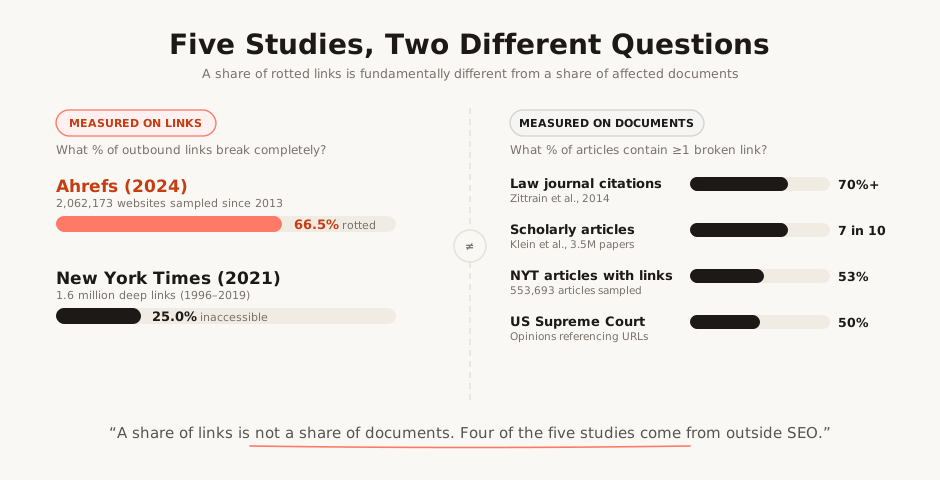
Ahrefs, 2024. A sample of 2,062,173 websites and the links pointing at them since January 2013. At least 66.5% of those links had rotted. Counting a further 6.45% with temporary crawl errors and 1.55% with other issues, the total the study treats as lost reaches 74.5% (study).
The New York Times, 2021. The paper analysed 553,693 of its own articles published between its 1996 launch and mid-2019, containing 2,283,445 external hyperlinks, of which 1,643,720 were deep links into specific pages rather than home pages. 25% of those deep links were completely inaccessible, and 53% of the articles containing them had at least one that had rotted. In a sample of 4,500 links that still resolved, 13% had drifted significantly from what was originally cited (Columbia Journalism Review).
Klein and colleagues, PLOS ONE, 2014. Over 3.5 million scholarly articles from arXiv, Elsevier and PubMed Central, published between 1997 and 2012, carrying more than a million web references. One in five articles suffered reference rot. Among articles that actually contained web references, seven in ten did (paper).
Zittrain, Albert and Lessig, Harvard Law Review, 2014. In a study of legal citation, more than 70% of URLs cited in academic law journals no longer produced the information originally cited, and 50% of URLs referenced in United States Supreme Court opinions had suffered link or reference rot (summarised by Harvard's Center on the Legal Profession).
PLOS ONE, 2024. A study of 2,166 supplemental data links from 1,419 repository records, published between 2014 and 2022, modelled decay over time: the odds of the data still being available fell by about 2.6% for each year after the article was published (odds ratio 0.974, 95% confidence interval 0.950 to 0.998) (paper).
Read that last one carefully, because it is the easiest to misquote. It is a change in the odds of availability per year from a statistical model. It is not a claim that 2.6% of links vanish annually, and rewriting it that way would be exactly the kind of drift this page exists to avoid.
The rate, where anyone has estimated one#
Most of these studies are snapshots: they measure what has already happened to a body of links of mixed ages. Only the research-data study models a rate, and it models one for a specific and unusual population.
So the honest summary is that decay is continuous rather than event-driven, and that nobody has published a reliable annual attrition rate for a commercial backlink profile. What every study agrees on is direction and scale: the longer a link has existed, the less likely it still works, and against the evidence.
What we measured ourselves#
We are running a monthly count across 44 SEO service and agency pages. Between 16 August and 15 September 2026, 40 of those pages were reachable on both dates.
| Metric | 16 August 2026 | 15 September 2026 |
|---|---|---|
| Total links | 842 | 820 |
| Losses | 52 | |
| Additions | 29 |
Fifty-two losses in a month looks like an event rather than decay, and it was: 39 of them were on
one page (linkbuild.agency), which underwent an editorial rewrite that stripped a set of author
links. The remaining 13 losses were scattered across 6 other pages.
Why a link disappears, and why "gone" is not one thing#
The studies count several different failures under one heading, and the distinction matters because each has a different repair.
The page was deleted. The most common and the least recoverable. Sometimes there is an equivalent page to point at instead.
The site was rebuilt and the URL changed. Very common, entirely fixable, and usually accidental. A publisher who moved from one CMS to another rarely intended to break anything.
The link was removed but the page remains. An editor updated the piece, a plugin stripped outbound links, or a policy changed. The page still ranks and still gets read.
The link still exists but points somewhere different. Content drift, which the Times measured at 13% of links that still resolved. The URL answers, but the thing it answers with is not what was cited.
The link is intact and no longer followed. Our own measurement found 0 qualifying changes across 820 links in a month. It is the only failure in this list that a link checker looking for a 404 will not see at all.
How to find what you have lost#
Any backlink tool will show you a lost-links report. Three things make that report more useful than it usually is.
Compare against something. A report of lost backlinks means nothing without an earlier date to compare it to. If you have never taken a baseline, take one now; the value of the report starts accruing from the day you have two of them.
Check whether the page is gone or the link is. These arrive in the same report and need different emails. Fetch the page. If it loads and your link is not in it, that is a different conversation from a 404.
Sort by what the link was worth to you, not by the metric. A link from a page that sends real readers is worth chasing. A link from a directory nobody visits is worth knowing about and not worth an email.
The version of this that does not depend on remembering is checking on a schedule, so that a removal surfaces while the publisher still recognises the piece rather than a year later.
How to ask for it back#
Short, specific, and easy to refuse. The full templates are in outreach emails that get answered; the reclamation-specific points are these.
Lead with the fault, not the favour. "The link to X on page Y returns a 404" is a message that helps them whether or not they act on your part of it.
Name the section. A publisher who has to search their own page for your link is a publisher who does something else instead.
Say what changed if you know. If your URL moved and you did not redirect it, say so. It is your fault, admitting it is disarming, and it makes the fix obvious.
Ask once. One follow-up at most. A link that was removed deliberately will not come back because you asked three times, and the request costs you goodwill you may want later.
What nobody has measured#
The most useful part of this page for anyone deciding where to spend effort.
Reclamation success rates are unmeasured. We looked for a published study on what share of outreach asking for a removed or unlinked mention to be restored actually succeeds, and found none at any sample size. A figure of 26% across 576 emails circulates in this subject; it could not be traced to a primary report and is not repeated here as fact.
Post-publication rel changes are barely measured. No study, vendor or academic, appears to have
measured how often a live link is quietly changed to rel="nofollow". Our month-long check found one change, and it was the addition of a security attribute rather than a removal of trust.
None of these studies measured a commercial backlink profile. They measured a newspaper archive, scholarly citations, court opinions and research data. Those are the populations where somebody had both the access and the motive to count. Whether a marketing site's links decay at the same rate is a reasonable assumption and an unverified one, and we would rather say that than round it off.
One further study, reporting more than 20% loss across 270 million URLs in web-sourced multimedia datasets, is left out because its paper could not be retrieved to check.
Sources#
All fetched and verified 15 August 2026.
- Ahrefs, link rot study, February 2024. 2,062,173 websites.
- Columbia Journalism Review, on the New York Times archive, 21 May 2021. 553,693 articles, 2,283,445 links.
- Klein et al., PLOS ONE, 26 December 2014. 3.5M+ scholarly articles.
- Zittrain, Albert and Lessig, Harvard Law Review, 2014, summarised by Harvard CLP.
- PLOS ONE, on research data availability, 5 June 2024. 2,166 data links.
- Our own count of 44 SEO pages, between 16 August and 15 September 2026.
All figures on this page other than the 44-page count are from the cited sources. We run a verification crawler and intend to publish what it measures; until it has run long enough to say something more, this page relies on other people's work and says whose.