Link Building Statistics, Traced to the Studies Behind Them
Most link building statistics you meet have been copied from a page that copied them from another page. Somewhere at the bottom of that chain is a study with a sample size and a date, and by the time the figure reaches you both have usually been lost, along with any sense of what was actually measured.
This page does the boring version. Every number below carries the study that produced it, how large the sample was, and when. Where two studies disagree, both are here. Where we could not find a primary source, the figure is in the last section instead of in the article.
How to read these numbers#
Two studies can both be right and still not agree, because they are not measuring the same population. That is not a technicality. It is the single most common way these figures get misused.
The clearest case is a pair of studies from the same publisher. Ahrefs analysed about 1 billion pages and found 90.63% of them got no organic traffic from Google. Later, Ahrefs analysed 14 billion pages and found 96.55% got none. Those numbers are quoted interchangeably. They come from different datasets, published roughly a year apart, and only one of them also carries the backlink distribution people usually cite alongside it.
Check the sample before you use the number, and treat a source that will not tell you its sample as a source you cannot use.
How much of the web has no backlinks at all#
Three large studies have asked this and returned three different answers.
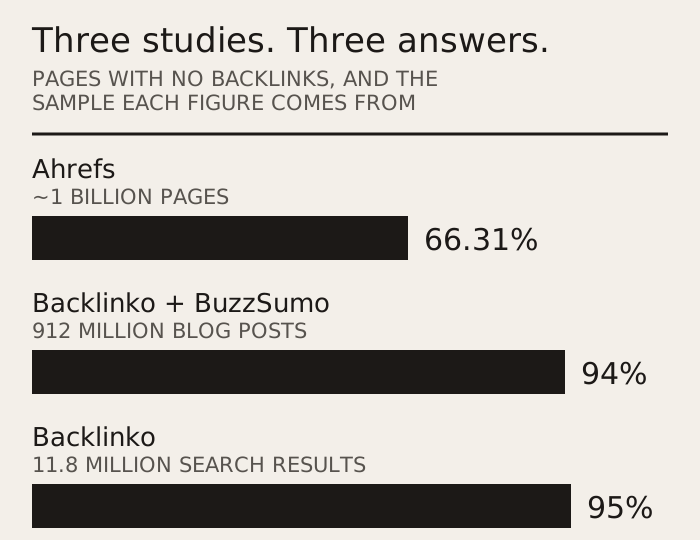
- 66.31% of pages have no backlinks at all, and 26.29% have links from fewer than three websites (Ahrefs, about 1 billion pages).
- 94% of blog posts have zero external links (Backlinko and BuzzSumo, 912 million blog posts, February 2019).
- Roughly 95% of pages have no backlinks (Backlinko, 11.8 million search results).
The gap between 66% and 95% is the gap between "every URL in a crawler's index" and "blog posts and ranking pages". Both populations are real. Which one you should quote depends on which one your reader is in.
From the same Ahrefs dataset: 90.63% of pages get no organic traffic and a further 5.29% get ten visits a month or fewer. In the larger 14-billion-page study, 1.94% of pages get between one and ten monthly visits.
A note on that first source, which this article owes you. Its original English and Japanese versions have been superseded by the newer study and no longer serve it: the Japanese URL now redirects to a blog index. The figures above are quoted from the surviving Chinese localisation, which still carries them verbatim. An article about link rot citing a rotted link would be a poor joke to leave in place.
How many backlinks do you actually need#
People usually want a threshold here, and there is not one. Any specific number you have been given was invented, because the answer depends entirely on what you are trying to outrank.
What the data does support is a shape. If two thirds of pages have no links and a quarter have three or fewer, then most of the pages you are competing with are not defended by much. That is checkable rather than theoretical: look up the referring domains of the pages currently ranking for your term.
We did that for one commercial keyword in August 2026. The pages holding positions five through ten had 1, 1, 1, 2, 2 and 4 referring domains between them. For a different keyword in the same market on the same day, the top ten pages held 11, 40, 43, 68, 89 and 196. Same industry, same week, two entirely different competitive situations.
The number you need is the number those specific pages have, and it is usually smaller than the advice suggests.
How links decay and disappear#
Links are not permanent, and the scale of that is the most reliably sourced statistic in this whole subject.
Ahrefs studied 2,062,173 websites and the links pointing at them since January 2013. Of those links, at least 66.5% had rotted. Adding a further 6.45% with temporary crawl errors and 1.55% with other issues, the total the study counts as lost reaches 74.5%.
Read that carefully, because it is often stretched. It is a measurement across roughly nine years, not a per-year rate. What it establishes is that a backlink is a thing with a lifespan, and that nobody is exempt from it.
The practical consequence is that a link you earned and never checked again is a link you may not still have. Knowing which of yours are still live is a matter of monitoring them on a schedule rather than of remembering to look.
What outreach actually returns#
The most quoted number in link building comes from Backlinko's analysis of 12 million outreach emails, published April 2019. It is worth being precise about what those emails were, because this is the figure that gets stretched furthest. They were link building, guest post, sponsorship, resource, review, mention and roundup emails, not cold sales prospecting. When you see 8.5% quoted as a cold email benchmark, it has been moved to an activity nobody measured it on.
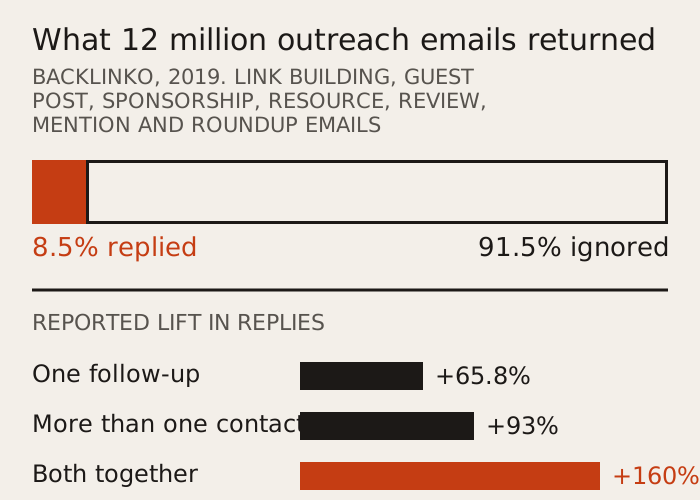
- 8.5% of outreach emails receive a reply; 91.5% are ignored.
- A single follow-up increases replies by 65.8%.
- Reaching more than one contact at a site increases responses by 93%.
- Doing both, a sequence to multiple contacts, gives a 160% higher response rate than one email to one person.
- A personalised subject line lifts response rate by 30.5%; a personalised body by 32.7%.
- Longer subject lines, 36 to 50 characters, outperformed short ones by 32.7%.
Source for all six: Backlinko, 12 million outreach emails.
Three of those findings point the same direction, and it is not the direction most people take from the 8.5%. The baseline is low because most outreach is one message to one address. The study's own numbers say the fix is more attempts and more care, which is the part of the outreach workflow that is tedious enough to get skipped.
Which kind of page collects links#
Here we ran out of other people's studies, so this section is ours.
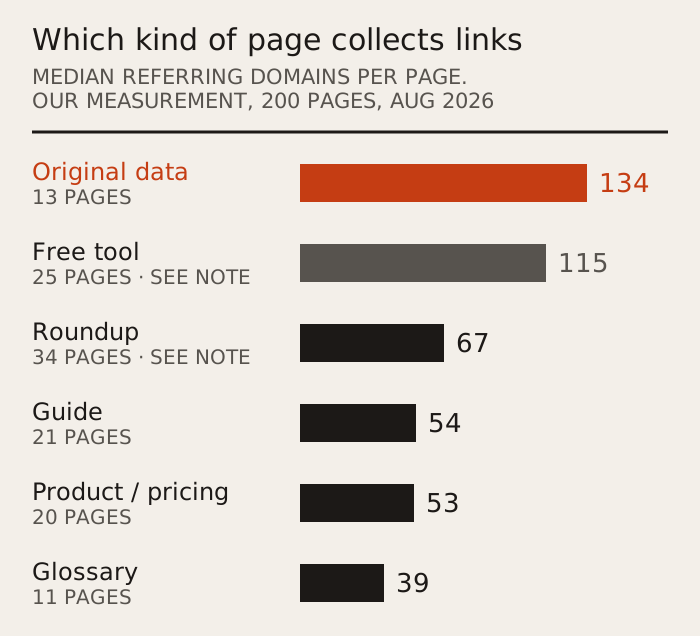
In August 2026 we measured the top 25 pages by referring domains on each of eight domains in the link building software market: four product companies and four publishers. That is 200 pages. Each was classified by what kind of page it is, and we took the median referring domains per type.
| Page type | Pages | Median RDs |
|---|---|---|
| Original data | 13 | 134 |
| Free tool | 25 | 115 |
| Roundup | 34 | 67 |
| Guide | 21 | 54 |
| Product / pricing | 20 | 53 |
| Glossary | 11 | 39 |
Two of those rows need their caveat stated rather than buried.
The free tool median is propped up by a single page holding 4,257 referring domains whose anchor text is mostly the name of a different product, because the URL inherited a redirect. Excluding it, the honest read of that bucket is closer to 104, accumulated over about a decade.
The roundup median is held up by seven statistics pages on one very large domain. Outside that domain, roundups in our sample ran from 8 to 119 referring domains with a median near 20. Roundups rank. On this evidence they do not collect links.
One more finding that did not fit the chart: comparison pages barely exist here. Across all 200 pages we found one, and it held 394 referring domains. A single page is not proof of anything, which is exactly why it is interesting.
The number that is not a link#
A caution about referring-domain counts in general, measured on ourselves.
This site went live on 15 August 2026 at Domain Rating 0, with 0 organic keywords. Within
about thirty-six hours it had acquired 51 referring domains. Not one of them carried a followed
link, 53 of 54 were flagged as spam by Ahrefs, and 43 of them were near-identical .shop
domains that appeared within hours of the DNS record changing.
That is what an automated network does to any domain that changes hands. It says nothing about the site. It does mean that a raw referring-domain count can move a long way without a single real link behind it, and that any statistic built on raw counts, including some in this market's comparison tables, is measuring something other than what it claims.
What practitioners say they do#
Survey data belongs in its own section, because self-reported behaviour is a different kind of evidence from crawl data and should not be mixed with it.
uSERP surveyed 800+ SEOs about link building tactics (uSERP, State of Backlinks). The figure usually quoted from it is that 40.7% consider content marketing the strongest source of passive links, and we are not going to quote it, because checking the page turned up something more useful.
That 40.7% appears in the report's own summary at the top. The body of the same report, asked which tactics give the strongest results, shows content marketing at 18% and digital PR at 20%. We cannot reconcile the two, and we are not going to guess which is right.
This is the whole problem in one page. A number sitting in a summary gets copied outward forever, while the body it summarises says something else, and nobody re-opens the report because the figure already looks sourced. It is the reason this article exists, found in the last source we checked.
What we could not verify#
These circulate widely and are not in the article, because we could not put a primary study behind them within the time we gave it:
- Anchor text distribution across real backlink profiles. Frequently quoted as fixed ratios of branded to exact-match anchors. We found no large-sample study with a stated method.
- The share of links on the web that are nofollow. Quoted confidently, sourced to nothing we could open.
- Referring domains held by top-ranking pages, as a general rule. Tool vendors have run this analysis, but we could not identify a specific published study to cite, so the figures in this article are our own SERP checks on named keywords instead.
- Link velocity thresholds, and how long a new link takes to affect rankings. Both are discussed constantly and, as far as we could establish, measured publicly by nobody.
- "0.07% of pages get more than a thousand monthly visits." Widely attached to the Ahrefs 14-billion-page study. We opened that study and it does not state it. Cut rather than carried.
If you know of a primary study for any of these, we would rather correct this page than keep the gap. The address is on our contact page.
Sources#
Every figure above comes from one of these, checked on 15 August 2026:
- Ahrefs, link rot study. February 2024, 2,062,173 websites.
- Ahrefs, search traffic study. About 1 billion pages. The surviving localisation; the English and Japanese versions no longer serve it.
- Ahrefs, 14 billion pages. December 2023.
- Backlinko and BuzzSumo, 912 million blog posts. February 2019.
- Backlinko, 11.8 million search results.
- Backlinko, 12 million outreach emails. April 2019.
- uSERP, State of Backlinks. Survey of 800+ SEOs. Cited for its sample and for the contradiction between its summary and its body, not for the 40.7% figure.
- Our own measurements, August 2026: 200 pages across 8 domains, and this domain's own backlink profile