Blogger Outreach Email Templates That Get Answered
Most outreach emails are ignored. In the largest public study of them, 91.5% got no reply at all.
That is the starting condition, and a blogger outreach email template only helps if it is built around it. What follows is five of them, each tied to a situation, with the reasoning attached. Every performance figure below comes from one source and is labelled every time it appears.
What the data says before you copy anything#
Backlinko analysed 12 million outreach emails in 2019 (study). Worth being precise about the sample, because this figure gets quoted as a cold sales benchmark and it is not one: these were link building, guest post, sponsorship, resource, review, mention and roundup emails.
| Finding | Figure |
|---|---|
| Emails that got a reply | 8.5% |
| Emails ignored | 91.5% |
| Lift from a single follow-up | +65.8% |
| Lift from reaching more than one contact | +93% |
| Lift from doing both | +160% |
| Lift from a personalised subject line | +30.5% |
| Lift from a personalised body | +32.7% |
| Subject lines of 36 to 50 characters, against short ones | +32.7% |
Three of those point the same way, and it is not where most people take the 8.5%. The baseline is low partly because most outreach is one message to one address. More attempts and more care move it, and both are boring work rather than clever copy.
The parts every one of these has in common#
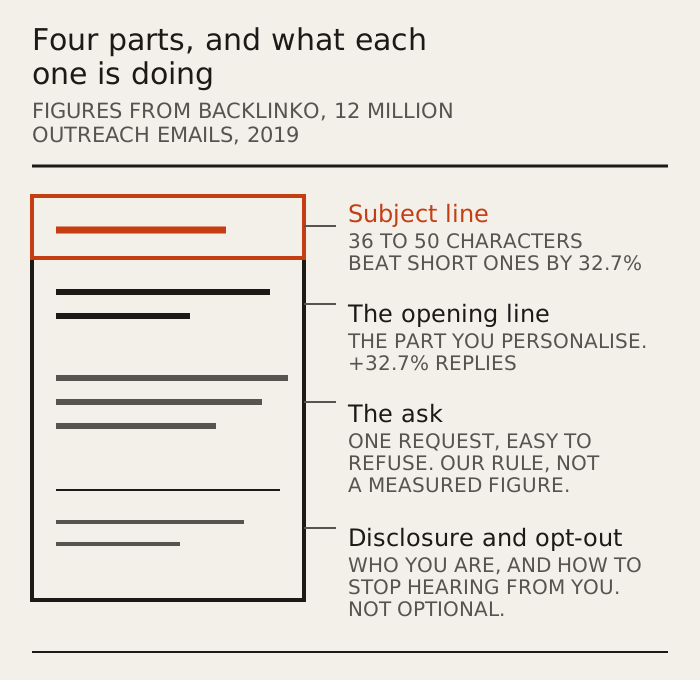
Four parts, and only the third is about you.
The subject line says what the email is, in 36 to 50 characters. Not a question, not a hook, not your company name.
The opening line proves you read the thing you are writing about. This is the part that cannot be automated well, and the part worth the minutes.
The ask is one request, phrased so that "no" is easy. A publisher who can refuse in four words often answers instead of ignoring.
The footer says who you are and how to stop hearing from you. It is the part everyone omits and the one that separates a person from a script.
The templates#
Five situations. Change everything in brackets, and delete any line you cannot say honestly.
When you are asking to write for them#
Subject: Guest post idea for [publication]

Hi [first name],

I read [specific piece] and noticed you cover [narrow topic] more
carefully than most. [One sentence on something specific in it.]

I'd like to write you something on [proposed topic]. The angle I have
in mind is [one line], which I don't think you've run.

If it's not a fit, no reply needed and I won't chase it.

[Your name], [role] at [company], [URL]
Not interested in pitches? Reply STOP and I'll remove you.
This is the shape people mean by a guest post outreach template, and the reason most guest post email templates fail is the opposite of length: they open with the writer instead of with the publication. The last two lines do the disclosure and the opt-out, and the "no reply needed" line costs you nothing while buying the recipient a way out that does not involve typing.
When you want a mention added to an existing piece#
Subject: Small addition to your [topic] piece

Hi [first name],

Your [article title] is the piece people send me when they ask about
[topic]. One thing it doesn't cover is [specific gap].

We published [your resource], which covers exactly that. If it's
useful to your readers, a line in [named section] would fit. If not,
that's a fine answer.

[Your name], [role] at [company], [URL]
Reply STOP if you'd rather not hear from me again.
This is the ask most likely to be answered, because it is the smallest. Name the section rather than the page.
When their page links to something broken#
Subject: Broken link on your [page name] page

Hi [first name],

The link to [broken destination] on [page URL] is returning a 404.
It's in the [named section], under [heading].

We have [your resource] on the same subject if you want a
replacement. Either way, the dead link is worth fixing.

[Your name], [role] at [company], [URL]
Reply STOP to be removed.
Lead with the fault and give the replacement second. An email that fixes their page whether or not they use your link is one they answer.
When you have data they could cite#
Subject: Data for your [topic] article

Hi [first name],

You cite [existing statistic] in [article title]. We measured the
same thing across [sample size] and got [your figure].

Method and raw numbers are here: [URL]. Use it with or without a
link, and correct us if we've got it wrong.

[Your name], [role] at [company], [URL]
Reply STOP and I won't write again.
The strongest of the five, and the one you cannot send without doing the work first. "Use it with or without a link" is not a trick: an unlinked citation still tends to travel.
When they mentioned you without linking#
Subject: Thanks for the mention in [article title]

Hi [first name],

Thanks for mentioning [your company] in [article title]. I didn't
know until it turned up in a search.

If it's easy, a link on that mention would help people find us. If
your house style is not to link, that's completely fine and the
mention is appreciated either way.

[Your name], [role] at [company], [URL]
Reply STOP to be removed from my list.
The easiest yes in outreach, and the one nobody asks for.
The follow-up#
Subject: Re: [original subject]

Hi [first name],

Following up once on the below, in case it arrived at a bad moment.

If it's a no, a one-word reply saves us both the guessing and I'll
close it off.

[Your name]
One follow-up, four to seven days later, on the original thread. The study found a single follow-up lifted replies by 65.8% (Backlinko, 12 million emails). Asking explicitly for a one-word no is what turns silence into data.
What to change every time, and what to leave alone#
Change the opening line and the ask. Those are the parts that are about them.
Leave the structure alone. The order matters more than the wording: what this is, why you are writing to them specifically, what you want, how to refuse.
And do not send the same template to a list. A template is a shape to fill, and the moment the filled part is generic the whole thing reads as a mail merge, which it will be.
The parts that are not optional#
Three lines that are absent from most templates you will find and present in all of ours, because they are the difference between outreach and spam.
Say who you are. Name, role, company, and a URL a recipient can check.
Offer a way out. One line. Honour it immediately and permanently.
Do not invent a relationship. No "I've been following your work for years" unless it is true. It is the most common line in outreach templates and the fastest way to be recognised as a script.
These are the same rules the pitches Pressmerit prepares follow: a disclosure and opt-out line in the footer, no deceptive subject, no fabricated prior relationship, and a body kept under 1,200 characters in the publisher's own language. The tools you use to send them are a separate question, and we compared four of them in BuzzStream, Pitchbox and Respona alternatives.
What happens after they say yes#
The part templates never cover. A yes is a placement, and a placement is not permanent: across 2,062,173 websites, at least 66.5% of links had rotted over roughly nine years (Ahrefs, 2024), and links change quietly as well as disappear. Worth checking on a schedule rather than remembering to look. The rest of those numbers are in link building statistics.
Sources#
- Backlinko, 12 million outreach emails, April 2019. Every performance figure on this page.
- Ahrefs, link rot study, February 2024, 2,062,173 websites.
Both checked 15 August 2026. No figure on this page is ours, because we have not run a study worth quoting yet.