Do Nofollow Links Help SEO? What Google Actually Says
Not the way a followed link does, and nobody outside Google can tell you by how much.
That is the whole answer, and most of what surrounds it online is a paraphrase of something Google's documentation does not actually contain. This page quotes what it does contain, then covers the part almost nobody writes about: what happens when a link you already earned quietly becomes a nofollow link, and why that is harder to notice than a link disappearing altogether.
The short answer#
Do nofollow links help SEO? Not in the sense the question usually means, which is whether they move you up the results page. They are marked precisely so that a search engine does not treat them as an endorsement, and Google's wording for what happens next is deliberately loose.
Three things are worth separating, because they get answered as one and they are not one.
Ranking value: unknown, and unknowable from outside. Nobody has a number, Google publishes none, and the confident figures you will find are inferences dressed as measurements.
Everything else a link does: unchanged. Traffic, discovery, the fact that somebody credible mentioned you. Nofollow links carry all of that exactly as followed ones do.
Harm: none. A marked link is a publisher's statement about their own site, not a mark against yours.
If you want the one-line version: treat nofollow links as worth having and not worth paying a premium for, and be suspicious of anyone who quantifies them.
What Google's documentation actually says#
There is one page, it is short, and it is worth reading rather than reading about: Qualify your outbound links to Google.
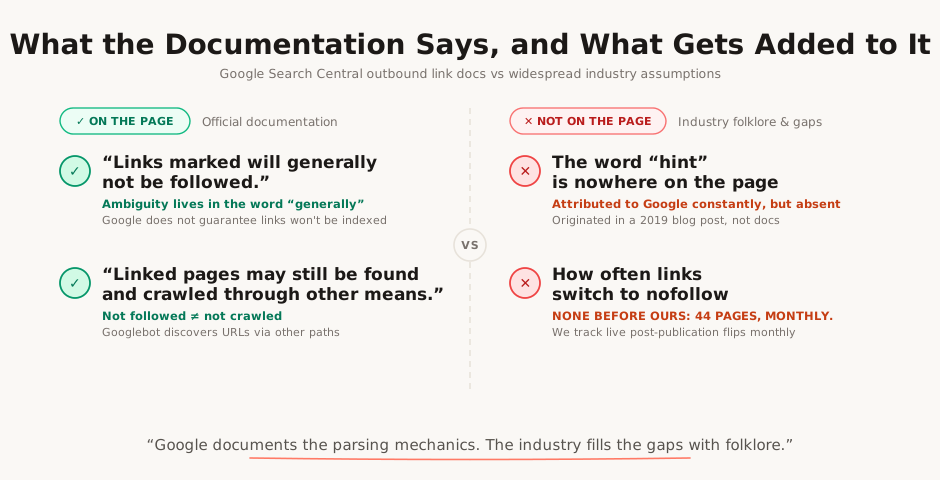
On what marking a link does: "Links marked with these rel attributes will generally not be
followed."
On what it does not do: "Remember that the linked pages may be found through other means, such as sitemaps or links from other sites, and thus they may still be crawled."
On when to use nofollow at all: "Use the nofollow value when other values don't apply, and you'd
rather Google not associate your site with, or crawl the linked page from, your site."
That last sentence reorders what most people assume. nofollow is not the general marker with
sponsored and ugc as special cases; it is the leftover for links that are neither advertising nor
user-generated and that a publisher still does not want to vouch for. The three values, and what
each one tells Google, are set out in
backlink types.
The word the industry adds, and the page that does not contain it#
You will read, in a great many places, that Google treats link attributes as "hints" rather than directives. It is the single most repeated sentence on this subject.
The word "hint" does not appear on that page. We checked on 15 August 2026, looking for exactly it. What the page says is "will generally not be followed", and everything the industry builds on top of that is an interpretation of one adverb.
This matters less as a correction than as a method. The honest position is that "generally" leaves room and nobody outside Google knows how much. Anyone who tells you a nofollow link passes a specific share of the value of a followed one is telling you something they cannot know, and the confident version of that claim is a reliable signal that the rest of the page is guesswork too.
What a nofollow link still does#
None of the following is in dispute, and none of it requires a theory about ranking.
It sends readers. A link on a page people actually read sends people who actually click. That happens whatever the attribute says, and for a lot of placements it is the entire point.
It can get a page found. Google's own wording above says the linked page may still be crawled through other means. A marked link is not a wall.
It puts your name somewhere. Mentions on sites an audience trusts do work that is hard to attribute and easy to underrate, including in the answers AI assistants now give.
It is often the only version available. Wikipedia, most large news publishers, and nearly every platform carrying user-generated content mark outbound links by policy. Declining those placements on principle means declining the most visible mentions on the web.
When a link you earned quietly becomes nofollow#
Here is the case this page exists for, and it is the one almost nothing else covers.
A link you earned six months ago is still on the page. The page still ranks, still gets read, still
sends you the occasional visitor. At some point somebody added rel="nofollow" to it, and nothing
told you.
It happens for reasons that usually have nothing to do with you. A site adopts a policy of marking all outbound links. A plugin update changes a default. A new CMS applies a template rule. An editor applies a sponsorship policy to a whole category. A publisher decides that links in a particular section are no longer editorial.
What makes it awkward is not the change itself but how invisible it is. A link checker looks for
links that are gone. This one is not gone. The page returns 200, the anchor text is unchanged, the
URL still points at you, and a report built around broken links will show you nothing at all. The
only way to see it is to look at the rel attribute on the specific anchor, which nobody does by
hand across a whole profile.
Links are not stable in general. Ahrefs studied 2,062,173 websites and found at least 66.5% of the links pointing at them since 2013 had rotted, rising to 74.5% counted as lost (study, February 2024). Against a background of that much churn, the idea that an attribute also drifts is not surprising. Until we started counting, below, nobody had counted it.
What we measured, and how small it is#
We went looking for any study, from anyone, at any sample size, that measures how often an existing
followed link is changed to rel="nofollow" or rel="sponsored" after publication. We found none.
The literature on link decay is rich, and we went through it: newspapers,
scholarly citations, court opinions, research data. All of it measures links that stop working. None
of it measures links that keep working and stop counting.
So in August 2026 we started counting. A script fetches the same 44 pages once a month and records
every outbound link with its rel value. The pages were in Google's top 10 in August for seven
searches this site writes about, "do nofollow links help seo" among them, which makes this a sample
of SEO publishing and not of the web. The method is set out in
our article on link reclamation.
| Snapshot | Outbound links recorded | Marked nofollow, sponsored or ugc |
|---|---|---|
| 16 August 2026 | 842 | 172 |
| 15 September 2026 | 820 | 143 |
| 15 October 2026 | 835 | 133 |
The same 40 of the 44 pages loaded both times in August and September, and a forty-first page loaded
in October. In those first 30 days, no link on them switched from followed to marked, or from
marked to followed. One link changed its rel value at all, and the new value was noopener, a
browser security setting that tells a search engine nothing. The fall from 172 marked links to 143
is not a change of attribute either: one page replaced most of its source list, and the 39 links it
dropped were all marked. On the other 39 pages the number of marked links stayed at 109. The third
run, on 15 October, changed nothing about that: no link switched from followed to marked, or from
marked to followed, in either month, and no link changed its rel value in the second interval.
Every marked link, in all three runs, was nofollow. Not one was sponsored and not one was ugc, on
pages that rank for questions about those very attributes. Marked links were also the minority,
about one in five or six.
None of this says how often the change happens across the web. It says the change is not common enough to show up on 40 pages in two months. We run the count every month and will add each result here.
How to check your own#
One link, by hand. Open the page, view source, search for your domain, and read the rel
attribute on the anchor that contains your URL. No attribute means the link is followed. nofollow,
sponsored or ugc means it is marked, and more than one value can appear together as a
space-separated list. A minute per link, no tool required.
A whole profile. Any backlink tool will report which of your links are marked. The limitation is that most report a current state rather than a change, so a link that was followed in March and marked in June looks the same in the report as one that was always marked. If your tool keeps history, compare two dates; if it does not, take your own snapshot now so that you have something to compare against later.
Continuously. The version that does not depend on remembering is re-checking each placement on a schedule, against the state it was agreed in, so that a change surfaces as a change rather than as something you eventually notice. For a link that came out of a negotiation, what was agreed is the thing to check against, and that is recorded when the two sides agree rather than reconstructed afterwards.
Sources#
- Google Search Central, Qualify your outbound links to Google. Every quotation above, checked 15 August 2026. The word "hint" does not appear on it.
- Ahrefs, link rot study, February 2024, 2,062,173 websites.
- Our own count: the same 44 pages fetched on 16 August, 15 September and 15 October 2026, 40 of them reachable across all three runs. Method in our article on link reclamation.
The counts under "What we measured, and how small it is" are ours, from a script that fetches the same 44 pages once a month. Every other figure on this page is someone else's, with the source named.